Friday, June 15, 2012

Vegetables and Cashews


We went yesterday to some villages with Sr. Cecilia of the Sisters of Presentation of Mary convent across the street from us.   


She invited us to accompany her on a trip to check on a well for a women’s community garden. She agreed to pay part of the cost of the well digging. It was time to confirm that there was water in the well before writing the check to the well digger. Now, at the end of the dry season, is the best time to determine whether a well is a success.


 (The garden, however, has been abandoned for a period of time because it is cashew harvesting season. Cashews provide the women a great deal of profit for a few weeks of effort. They will start the garden again after the cashews are done and the rainy season begins.)

There are other wells in the garden. Only one of those is deep enough to provide water. To use that well they throw a bucket and draw the water up with a rope while crouching on the ground, as there is no rim or fence around it. Anyone can fall in. We heard the croak of a frog inside, but saw neither beast nor human stuck in the well. 

The new well has a high cement rim and a wooden pole to support and balance the two hanging buckets, so this one is a completely different story.  I did ask about children. Sr. Cecilia said she never heard about a child falling in a well. 

The village women do all the planting, weeding, maintenance, and harvesting of their vegetable gardens.  It is very hard work. During the dry season, they have to dig the hard soil and carry many buckets of water for long distances.  We do the same in our little garden, with a watering can twice a day.  But our garden is small and the faucet is not far away.


After our visit to the garden, we went to the cashew orchard to see what is going on.  We learned a lot about cashews, having never before seen a cashew tree or the fruit.  The cashew apple is beautiful. It is red or yellow and looks like a little apple. (It tastes like an apple too.) The nut hangs on the bottom of the apple.


 When the fruit is ready, it falls off the tree and the women collect the fallen fruit at 6:00 AM each morning.  They tear the nut, which is encased in a thick green shell, off the apple.  They sell the nuts in their shells and get 40 Gambian Dalasis for a tin of nuts. It is about US $1.30, a lot of money for them, certainly more than they earn selling vegetables.  The nuts need to be treated and processed before sale to consumers.


The cashew apples are useful as a source of cashew wine.  When cashew fruit are shipped to India or Viet Nam for advanced processing, they can be made into seven separate products. Here, in The Gambia, the processing technology we observed employs simple materials and equipment that are readily available. It is a technically simple process but hard work for the women. However, they are not able to realize the full value of seven products from their harvest, as in more advanced countries.

To produce alcohol, the women pound the apples and then squeeze the pulp with their hands to get the juice.  They do it on a wooden log that had been hollowed into the shape of a canoe. The juice is stored in 20 liter plastic cans for three days to ferment. When the liquid is red, it is ready for distillation. The brew is transferred into a 55 gallon recycled oil drum to be heated and distilled. The vapor passes through a copper pipe which is coiled to fit into another 55 oil drum full of water to cool and condense the vapor into liquor. This is all done in the orchard.


The resultant liquor is fairly strong, clear alcohol (We tasted it, of course.) It is stored in 20 liter containers and sold to business people who come to the village to buy it. There were men there too, but they seemed to do the less heavy-lifting jobs, like minding the fire, watching the process, perhaps doing the selling.

This cashew wine production is done by Christians, as the Muslims avoid alcohol. We also saw the palm nuts, another source of alcohol called palm wine.


Palm wine is the preferred beverage, but it is in short supply.  When the palm wine supply runs low, the price of cashew wine goes up. The women can collect enough income from the cashew wine to meet the expenses of their families for the whole year. The work is done communally, moving the processing from one owner’s trees to another.

A young man told us the cashew’s shells contain gas that should be removed by cooking or roasting before the skins are removed.  He threw some nuts into the fire and we saw the gas going up in flames.  Later we peeled the skin and ate the nuts. They were delicious.

We went to another village where we walked quite awhile in the hot sun to visit another garden and also go to the river, where the women were working to convert oyster shells into lime. It seems that much of the work in villages is done by women.


Sr. Cecilia is 80 years old and walks around very vigorously.  She drove us herself in the convent's SUV, unlike most in The Gambia, who have a driver. (The driving can be extremely challenging. Some of the roads are not roads, just narrow sand trails.)  I guess one should hope to keep going like her.  David and I were exhausted when we got home and had to take a long nap. 

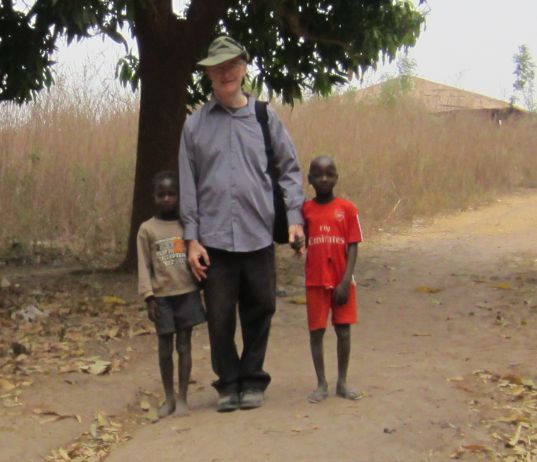
I turned grey here, as I thought it was a good opportunity to stop coloring my hair.  I don't like the result, but our hair looks more alike now.  Gambians often refer to us very respectfully as their parents or grandparents. I’ll see what happens when I am back to the society that worships youth.  Here people do not as often survive to ripe old age so we see fewer older people.  The head ties, hair extensions, and wigs most women employ are also helping to maintain their good appearance.

The aroma coming from the cashew apples is very strong now.  There is a single tree near our house. When I open our door, the smell hits me.  I guess it comes from the fruit left to rot on the ground, which ferments and turns to alcohol naturally.  One of our mango trees is full of overripe fruit, which also has a strong scent.  Other trees still have hard, green or purple, unripe fruit.  Once the rain starts, more of the fruit will ripen quickly. I made some mango jam and gave a couple of jars to friends.  I have few tools in the kitchen to do stuff I could easily do at home.  Chopping or mashing fruit is very difficult and I don't have the tongs to grasp the hot jars. (Instead, I use a pair of pliers David bought to fix things in the house. In this kitchen I have to improvise a lot.) I wish David were better at discussing menus as I have invited a Swedish couple for lunch tomorrow and they dislike Gambian food.  I am trying to think what to make and spent all morning in town looking for interesting veggies. (Not much success.)

The humid season has arrived.  It hasn't been too bad until a couple of days ago.  Usually there was a cool breeze in the early morning and at night.  Now it is more humid and it remains hotter at night.   The fan is a life saver.  We do have air conditioners in the walls of the bedrooms but are waiting until the heat becomes intolerable.

ooo

(Views expressed are my own)

Sunday, April 22, 2012

A Placement at Last!


We moved to this house. It is a great relief.  I am able to sleep better at night and, when waking up, I can go to the bathroom as I am without having to put a piece of clothing on.  The house is nice and quite isolated. Only the Director General of the National Agricultural Research Institute (NARI) lives nearby. I believe there are no other residents. It is where the offices and labs are of NARI, the partner organization we work with. 


Of course a move is a lot of work. Once they left all our belongings on the floor the work started.  The house has not been occupied for some years and although they painted it and did some repairs there were/are many things to fix.  The carpenter varnished some wooden doors and in the process spilled drops of brown varnish all over the tiled floor. No one cleaned it on time so the spots dried.  The water heater in the bathroom was broken so a plumber was called and he changed the heater but did not connect it.  Further, now the pipe there is leaking. The bathroom sink leaks too. Now there is a leak behind the toilet.

Anyway, with the help of our cleaning lady, Yama, and a lot of elbow grease and a razor blade and some borrowed tools, we are doing much better.  We have two bedrooms. We set the computers in the guest bedroom because that spot has the best wireless internet reception. The furniture was provided included ome enormous, ugly and dusty easy chairs in the living room.  We have noticed that in all the private homes we have visited there are very large sofas and chairs, and they hang dark curtains all around the walls and windows, making it very dark. We removed some of these curtains that are hung in such a way that you are unable to draw them closed or open. We open the windows when there is cool breeze. We tie the curtains to let the light in. We close them when the sun is shining in.  It is getting hotter every day, particularly in the afternoon.  Today it was 36C/95F degrees.

There are many mango trees around us and birds too (today we saw Red- collared widow birds, all black birds with a very long tail. The mangoes will not be ripe for several months; then it will be a feast of them.  Today we discovered a lemon tree near the house, with few lemons left high at the top. We used a long stick to pick 6 of them.  I always wanted a lemon tree in my yard.  


It is very quiet and peaceful in this location because it is outside the next town (Brikama).  There are no shops in walking distance. Today we went by the public transport (vans that are very crowded) to the next market in Brikama and returned by taxi with our heavy bags.  I will also be going to the city three times a week for my French classes at the Alliance Francaise--something fun and useful I chose to do before I knew that I will be living quite far. It takes me about an hour each side with some walking too.  I go earlier so that I can drop at the supermarket to buy ingredients we can't find in the local vicinity, and carry it back in my backpack. 

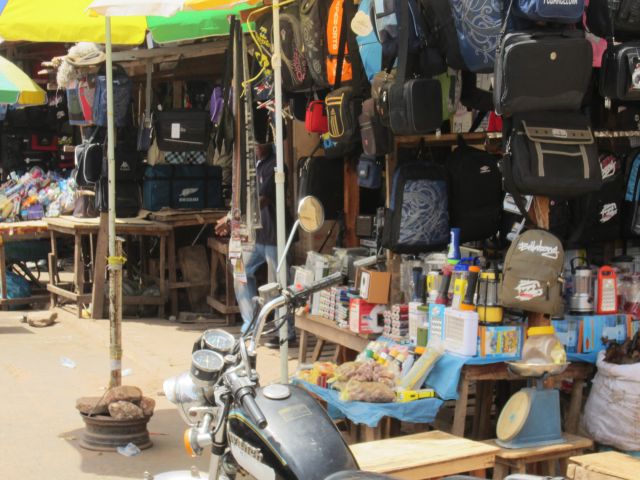
Since David works at home, and there are no places to eat out, there is a lot of food preparation involved.   The market is a crazy place. Any product (not food) is imported from China, mainly, and is cheap and generally poor quality. We bought a cheap pot for cooking rice, after another we bought earlier fell apart after the first cooking.  The new one had to be reinforced before cooking but the rice came out fine.

Today each one of us took a bath for the first time in the bathtub, with hot water heated on the stove in the kitchen.  Though it was only about 3 centimeters deep it was much better than the bucket wash we have done before. Once the water heater gets wired and fixed we can take warm showers.

Our son, Daniel is coming for a two-week visit next Tuesday.  He does not understand the conditions here (no ATMs, can't use credit cards and the need to use cash everywhere.) The day after he arrives we go together on a trip to what they call "up country," where NARI has an experimental station where our project, to set up the computer training center, takes place.  We plan to interview the prospective trainees to assess their training needs, and see how the Center's renovations are getting along.  On the weekend we will go sightseeing and stay at a bird-watching camp.  Dani will probably take also some day trips around the coastal area where we live, and sometimes one of us can join him.


We traveled to Sapu expecting to interview up to 20 staff. We brought 20 copies of the questionnaire.  We interviewed 30 staff and, unfortunately, had to turn additional staff that was anxious to participate away.  Staff traveled from all over the region to participate in the interviews.  The staff interest in the opportunity to learn how to use a computer is overwhelming and very encouraging.  My impression is that the demand for enrollment in the training centre will likely be very great and may require prioritizing who is trained.


Our findings will lead to several additional recommendations for the implementation and further development of the training centre project.

First, there is a history which has been essentially unknown to us. We met a Peace Corps volunteer who told us that there had been a computer training programme at Sapu beginning in 2008. The project was terminated. The termination of this project came up in quite a few of our interviews. Staff expressed a great feeling of disappointment about the withdrawal of this training.  They also said that since they had had no opportunity to access computers in ordewre to put into practice what they had learned after the training, they had forgotten what they had learned and felt they would need to start over from the beginning to learn, again, the basics of using computers.

This story points out a concern and pitfall for a project of this nature. The training centre at Sapu will only make a meaningful impact and achieve the objectives stated for this project if access to computers for the Sapu staff follows the training, and the computers are serviced and supported to ensure that they continue to function by being repaired when they break down.  Providing the training without an enhancement of computer availability and support, and improvements in network and support infrastructure risks leading, again, to the kind of disappointment that staff at Sapu experienced when the Peace Corps withdrew from the training project initiated by the Taiwan Technical Mission.

Second, we learned, as result of the trip, that there are two major groups among the staff who will need to be served quite differently.  One group is novices who have never seen, touched, or experienced computers and have interacted very little with electronic devices, mainly because they have not had access to this kind of equipment. The second group has already been using computers to some degree for their work.

One of the staff that I interviewed told me his story. He is an agronomist and specialized in rice cultivation. He is a specialist for the extension workers.  When the extension workers bring a question or problem related to rice back from a farmer this staff person is the one an extension worker consults for an answer or possible solution.

A while ago he was sent to a meeting of agronomists in Egypt.  Agronomists representing 20 African countries attended this meeting. He represented The Gambia and he felt very embarrassed because he was the only one among the 20 who was computer illiterate. The representatives of the other 19 countries had computers and knew how to use them.

After the meeting he was able, through the help of an NGO in Nigeria, to obtain a laptop.  He has taught himself how to use it and can borrow a dongle from the current station manager to access the internet in order to Google on topics related to rice. In this way he has been able to find information from other African countries, Japan, China, etc. in order to solve problems and answer questions for the extension workers.

The third point, a very important one, arises from our activities over the weekend. Since our son is visiting us, we booked accommodation at a guest house near Baboon Island. The guest house was operated by a husband (Gambian) and wife (Scottish).  He is the brother of the akalo and the imam of his village. We visited the Horse and Donkey Trust that teaches farmers and youth to care for farm animals, provides farm animals to poor farmers who can not afford them, thereby increasing their income by 500%, teaches computer skills in the village school, is in the process of reopening a primary care clinic which shut down due to loss of funding, and women's vegetable garden project. (Word of our interviews at Sapu had preceded us.  They had heard in detail about the training centre (an hour's drive from Sapu) before we arrived.)

ooo


We saw the chimpanzees and hippos. We toured their village and a Malian village that this village hosts. It was very interesting and significant for me. After the river tour we landed on the north side of the river at Kuntaur.  Our guide took us to meet the Assistant Regional Director CRR-North, Ministry of Agriculture.  His question was, when will the MOA staff at CRR-North be able to access training and learn how to use the computers that are located in their office? The point is that we heard that the need and interest in this initiative is becoming widespread and that the training centre at Sapu should be viewed as only a beginning.

ooo

We had a 100 degree day a couple of days ago.  Today it was much cooler, only 94.  We have just returned form an upcountry trip.  Up country it is really hot; it was for sure well over 100.  We did a little tour and saw hippopotami, Chimpanzees, Baboons, Bush Pigs, and many birds, though the nature was the least of it.  We stayed in a guest house in the bush in a small village near the river.  This is the time of year when the sun is directly overhead, and everything is very dry, so the cattle are coming from Senegal to get water from the Gambia River.  At night it was totally silent.  No machines, no planes, nothing.  We could see the Milky Way.  No lights. No electricity, no running water. Just nature. The proprietress, however, from Scotland, presented wonderful European meals.  Her husband, Gambian, gave us tours of the villages and the river.  Being a farmer himself and owning in his family a lot of land, we learned a lot about the life here. Our son is with us for a visit and is seeing the real Gambia. 
 
We are bit exhausted right now.  Ilana is lying down.  We spent the morning working on our garden.  For me it was heavy work because I was preparing the ground for planting.  I prepared a flower bed in front of the house and four mounds, two for zucchini and two for water melons.  Wouldn't be nice if they grew and were ready before we leave! No promises in this business. 


We found seeds yesterday during our foray into town.  We were invited for lunch at the house of another volunteer and stopped at the supermarket on the way, the one that has almost everything.  It is an hour away, so it is not available for a quick trip to pick something up. After the lunch we went to a five star hotel for hair cuts.  The hotel is owned by Moroccans, and the barber is Moroccan.  These were our first haircuts since arrival. It was about time and we figured it was better to make an appointment at that place than try the local places where all they do is shave your head.  Most people here don't have much hair.  Many women who are fashionable wear wigs.  In the village they wear scarves or a head dress. 


ooo


(The views are my own.)


Saturday, February 25, 2012

In Transition.....


Recently, five young people came to stay in the house where we have been living during our in-country training and also while we wait for accommodation. VSO uses the house for volunteers in transition, usually for a couple of weeks, during initial training, if they are destined to work in “up country,” meaning rural areas.  In our case, since the original accommodation arrangements for our placement didn’t work out, we will probably end up spending one–third of our stay here waiting for a place to live and work. 

Of the two men, both doing IT, one is from Kenya, and the other from Indonesia, also a David. He is to be the trainer for the same project we work on. 

There are also three women staying here, one is from Glasgow, Scotland, one is English, and the last, is a woman born in Brazil and raised in England. 


You can imagine the morning rush as seven people vie for the two bathrooms, each with his or her habits and need to wash some clothes, have breakfast, etc.  Luckily, they go to training about 8:30am to 4:00pm and we stay at here, so we can wait until after the rush. David sometimes works on the computer early in the morning before others get up.

On Saturday the two of us went to the market to buy fabrics.  We bought several, doing a lot of bargaining. We only bought inexpensive stuff, not more than two dollars a meter. I bought for myself fabric to make a skirt, a top shirt on top and a pair of slacks.  I will use my own clothes as patterns for the tailor rather than asking for Gambian style clothes.  The women wear narrow skirts with top blouse that are both very tight all over. Many of the young women are slim and tall and look wonderful in these clothes, but I wouldn’t.  They use locally printed fabrics that are colorful with multiple patterns and colors and wrap a piece of cloth on their heads. They look stunning! The fabric is stiff due to the use of wax to make the batik pattern. 
I bought thinner, softer cotton and already have a dress made which would be great in the hotter season coming soon.  We also bought fabric for making a Caftan for David.  On Friday you see many men wearing them, and most outfits are very attractive. David thinks he can use that on formal occasions as he did not bring over a suit.  We will go to the tailor next door tomorrow.  The tailor charges about ten dollars for making a dress (it is cheaper in the rural areas, but right now we are staying in the city.) 

The meals have turned into events for our little group.  David, the other David, from Indonesia, found a Chinese grocery store where he can buy ingredients suitable for his cooking.  And he is a cook.  He is a man of many talents. Last night we celebrated Valentines Day.  Gambians never miss a holiday or a celebration, so yes, Valentines is on the calendar here. I (David) went to the store to buy some little things (artificial roses) for the ladies living here now.  Also I bought a big bar of chocolate for the other David because he has been so good to us with his cooking. Ilana prepared tabbouleh and a potato salad.  David prepared vegetarian spring rolls, the best you ever tasted, a noodle dish with mushrooms, and a kind of dish from summer squash, something quiet to clean the palate at the end. The spring rolls came with a spicy soy based sauce and the noodles with a clear sauce made from stock, I believe.


It was a real feast and everyone had a wonderful time. Johnny, the Kenyan joined in for the first time.  Other nights he has been out crawling pubs and watching football games, which he is passionate about. They want to have another feast tonight, this time inviting the three additional new volunteers who already have housing, so have not been part of this little tribe to the same extent.   This will make us ten. David will be the lead cook and Ilana will probably do something as well. We were told that after this week, the volunteers will disperse to their assignments unless they need motorcycle training, which takes another week. (It turns out that they will be here much longer because of a scheduling problem with the British High Commissioner.)

oooo

I went to pick up a caftan using the fabric we bought and had sewn at a tailor down the street.  It turned out well.  It is something to wear at an occasion since I didn't bring a suit. A lot of Gambian men wear them, especially on Fridays.  I want to get a Muslim hat as well.

We were planning to go to Brikama today to have a look at how the preparation is progressing for our move there. On the way I saw a sign for a solar restaurant.  We went up a side street to check it out.  It was a quite interesting experience.  Here is a web site.  Check it out!

http://www.tiloo.ch

(Use Google to translate this from the German.  It comes out in pretty good English.)

The next stop was the Alliance Francaise. This is a wonderful oasis, a nice escape from the dust, noise, poverty, chaos into a different world.  Ilana enrolled for French classes. 


Then we had lunch at the cafe. A European plate was 150 D.  This is about $5.00.  There was an African plate as well for 40 D, or about $1.25.  We ordered the African, not knowing that it was fish on rice, a kind of Gambian broken rice with a few vegetables.  The fish was quite good. I ate Ilana's fish and she ate the rest.

It was getting quite hot.

We walked the rest of the way to Westfield, a major hub of traffic.  I felt like we were in a movie.  The crush of people, cars, smells, noise, it was overwhelming.  We found a gelly gelly going to Brikama.  


These are vans that are supposed to hold 14 passengers.  There were 23 in ours.  

 We were on seats as small as could be for people in the back so at least people didn't have to crawl over us when entering and leaving.  There are two workers for these vehicles, a driver and a conductor, though there is another name for him here, the boy. He collects the money, opens and closes the door. And he yells out the destination, looking for riders. Stops are frequent. The cost to Brikama, 40 km was 15 D, $0.50. The vehicle came to this country used, the entire interior was gone, and there were holes in the floor due to the wear of many feet. Most vehicles have writing in German, Dutch, French, depending on the country they came from. Ours belched smoke because the diesel is beyond worn out. 


Ilana was quite worried because it turned off the main road to pass through inner neighborhoods to catch more riders


When we arrived at NARI in Brikama, Mr. Mamadi Kejena greeted us.  He is the man at the reception desk at the National Agricultural Research Institute headquarters in Brikama.  He is so warm.  He is so helpful.  He made us feel welcome and good, glad to be there even though the journey was a bit harrowing. (I had been dreading riding in these vehicles.  It is sort of like a first dive into a cold swimming pool, a bit shocking, I guess.) 


(The views are our own.)